email jose.bonilla@cimav.edu.mx
phone +52 81 1156 0809

November 1st - 5th, 2026
Rivera Maya, México
days
hours
minutes
seconds
Conference themes
1. Polymer Synthesis (PS)
This symposium will explore new synthesis strategies, fabrication routes, and advanced manufacturing approaches for the preparation of well-defined polymers. Both oral and poster contributions are welcome in the following topics but are not limited to:
- Green polymerization methods
- Complex and supramolecular synthesis
- High throughput polymer synthesis
- Polymerization methods for self-assembly
- Precision polymer synthesis
- Reversible-deactivation radical polymerization (RDRP)
2. Polymer Physics and Characterization (PPC)
This symposium focuses on the fundamental understanding and advanced analysis of polymer and polymeric materials, bridging core physics with state-of-the-art polymer characterization techniques. Sessions will cover topics such as molecular structure–property relationships, optical, mechanical and thermal behavior, spectroscopy, microscopy, and emerging analytical tools that drive innovation in polymer science. By bringing together experimentalists, theorists, and industry researchers, the symposium fosters cross-disciplinary exchange and highlights how deep insight into polymer physics and characterization accelerates the development of next-generation polymers materials and technologies. Both oral and poster contributions are welcome to strengthen collaborations within the polymer community and to promote rigorous characterization as a cornerstone for innovation in polymer science and engineering.
3. Biopolymers for Biomedical and Health Applications (BP)
Biopolymers are macromolecules derived either from biological systems, living cells or synthetic biodegradable polymers including polysacharides, peptides, polynucleotides and other natural polymers (polyhydroxyalkanoates, rubbers, etc).
In this simposium, contributions related to the structure, biochemical and biophysical properties of these macromolecules and their composites will be appreciated. The utilization of bio-based materials in the development of eco-friendly products toward circular economy, biomaterial for biomedical and other high-tech applications will be also considered.
4. Polymer Materials for Advanced Technologies (PMAT)
This symposium focuses on polymer materials developed for advanced technologies, including energy, biomedical, electronic, and industrial applications. The emphasis is on functional polymers designed to achieve specific technological performance. Topics include, but are not limited to: Polymeric materials for energy storage and conversion systems (batteries, fuel cells, electrolyzers); Electroactive and ion-conducting polymers; Membranes for biomedical applications and gas and liquid separations; Polymeric materials for electronic and optoelectronic applications; High-performance polymers for automotive and aerospace applications; Multifunctional polymer systems for emerging technologies.
5. Polymers for Environmental Applications (PEA)
This symposium is open to welcome contributions on the field of polymers for sustainable and environmental applications. Interesting topics addressing the development of environmentally friendly materials using renewable or natural polymers, involving new polymer recycling strategies, bio-based polymers, biodegradable polymers, bio-inspired materials, and green chemistry, are suggested but not limited. All these efforts focused on the use of polymers for the storage and conversion of efficient and clean energy; gas and liquid separation; treatment and purification of water, soil and air; sustainable and non-toxic based materials; recycling and upcycling; and eco-friendly methods.
6. 3D/4D Printing of Polymers & Composite Materials (3DP)
This symposium will focus on the fundamentals and applications of Additive Manufacturing (3D printing) including: 3D Printing of Polymers, Biopolymers and Ceramics; 3D Printing of Composites and Nanocomposites; Creative and Adaptive Novel Additive Manufacturing Technologies; Novel Applications Based on 3D Printing; Artificial Intelligence and Machine Learning for Enhancing the Design of Materials in 3D and 4D Printing; 4D Printing and stimuli/responsive materials; Advanced 3D printing techniques and hybrid manufacturing; 3D Printing in Health, Medicine & Food; 3D Printing in Space & Aerospace; 3D/4D printing for Biomedical and Tissue Engineering.
7. Polymer Rheology and Processing (PRP)
This symposium highlights recent advances in the rheology and processing of polymeric materials including solutions, melts, and composites. Topics encompass non-Newtonian flow behavior, viscoelastic characterization, and structure-property relationships across theoretical, computational, and experimental approaches. Contributions addressing materials ranging from simple fluids to complex materials with hierarchical microstructures are welcome.
8. Polymer Nanocomposites & Hybrid Materials (PNH)
This symposium focuses on recent advances in the design, synthesis, processing, and characterization of polymer nanocomposites and hybrid materials with tailored structure–property relationships. Topics of interest include polymer-based systems incorporating nanoparticles and nanofillers (e.g., graphene, carbon nanotubes, nanoclays, polymer, metal, and metal oxide nanoparticles), bio-based hybrids, organic–inorganic networks, and multifunctional materials.
9. Food Polymers Functionality and Applications (FP)
This symposium is focused on biopolymers immersed in alimentary systems and their applications in the food industry. In addition, to the use and development of emergent technologies for extraction, stability, and preservation. Emphasize the importance of sustainability throughout the symposium, highlighting how the use of biopolymers in the food industry contributes to circular economy principles, waste reduction, and biodegradability.
- By chemical structure and nature
Biomaterials such as polysaccharides (starch, cellulose, etc.), polypeptides, lipids, proteins, and microbial biopolymers. - By applications
Enzyme immobilization, catalysis, adsorption, additives (foam stabilization, gelling agent, emulsifier, among others.), film forming, microencapsulation materials. - By function
Natural ingredients, supplements, prebiotics, antibodies, adaptogens, biological activity (antioxidant, anti-inflammatory, etc.), functional food.
10. Polymerization and Polymer Systems Modeling (PM)
Contributions are welcome on the subject of mathematical modeling of polymerization kinetics and polymer systems for the prediction of structure and/or properties using any of the diverse techniques, such as differential equations, kinetic Monte Carlo, molecular dynamics, computational chemistry, among others.
11. AI/Machine Learning for Polymers (IAP)
This symposium will focus on the fundamentals and applications of artificial intelligence (AI), including machine learning (ML), and data-driven methodologies in polymer science and engineering. Topics of interest include machine learning for polymer design, AI-assisted property prediction and polymer characterization, deep-potential models for molecular dynamics, and AI applications in multiscale modeling of polymers and polymer composites. Contributions addressing emerging applications of AI in diverse topics of polymer science will also be welcomed.
12. Poster Session
Organizing Committee







IBEROSTAR
Rates are per room, per night, on an All-Inclusive Plan

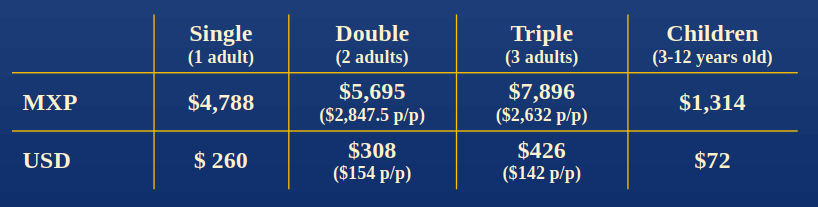
- Taxes for service and tips are included. Governmental State Environmental Sanitation Fee will be applied per room, per night (33.94 MXP, single or 50.91 MXP two or more people)
- Rates apply 3 days before and 3 days after
- Maximum occupancy per room: 2 adults and 2 children, or 3 adults and 1 child.
- Check-in: 3:00 p.m. / Check-out: 12:00 p.m.)